
My ESL co-teacher is a pig who can't read
By Jonny Hicks
For 10 years, my one-on-one students have never played a game against me. They've played against Bruce.
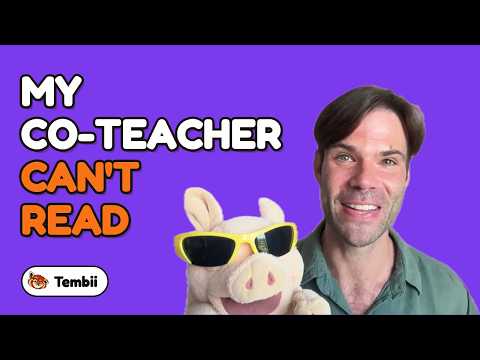
Bruce is a pig. More exactly, he's a puppet: a sassy Southern pig with a gruff voice, a heart of gold and a very high opinion of himself. He has been in every class I've taught, sometimes with one of his friends. This post is about teaching with puppets in one-on-one ESL classes: why a puppet solves a real problem, how to build one your students love, and how I use him with Tembii.
Why one-on-one classes need a second player
A game needs an opponent. In a group class, students play each other. In a one-on-one class, the only other person in the room is the teacher.
That puts you in two jobs at once. You run the game and you play against the child, and those two jobs pull against each other. If you win, you beat a seven-year-old. If you lose on purpose, children usually notice.
A puppet splits the jobs. I run the game. Bruce plays it. The student gets a real rival, and I stay on the student's side.
Meet Bruce
Bruce is a self-proclaimed genius. He will tell you so, often, in a big Southern drawl.
He also can't read.
That one weakness does more teaching than anything else about him. Every question in a game has to be read to Bruce, so the student reads it aloud. Then Bruce needs help choosing an answer, so the student explains the options to him. Reading to help a friend feels very different to a child than reading because the teacher said so.
Bruce has friends, too. Bill the Shark is meek, with razor-sharp teeth. He claims to be dull, but he's actually a little more clever than Bruce. Students still help him.
The trick that does the teaching
Sooner or later, most of my students make a discovery: they can trick Bruce.
Because Bruce trusts them to read the question, they can steer him to the wrong answer. He picks it with total confidence. Then comes the best part. Children will defend the wrong answer and explain, in English, why it is "correct."
Look at what that takes:
- They read the question aloud for Bruce, so every question is reading practice.
- They have to know the right answer to steer Bruce away from it. You can't trick someone without understanding the question.
- They explain their reasoning when they argue for the wrong answer, which is the kind of extended speaking that is hard to get from a young learner any other way.
Students find this on their own, and it has become one of the most useful parts of my classes. A student who can trick Bruce has to understand the question first.
How to build your own classroom puppet
You don't need Bruce. Any puppet works, even a sock. What makes a classroom puppet work is a character the student can predict and care about. Here's what I would suggest:
- Give the puppet one weakness the student can fix. Bruce can't read. Yours might not know colors, mix up days of the week, or always forget the word for "spoon." The student's job is to help.
- Pick two or three traits and keep them. Bruce is sassy, sure he's a genius, and kind underneath. Children love knowing how a character will react.
- Give the puppet a voice. It doesn't need to be good. It needs to be different from yours, so the student always knows who is talking.
- Let the puppet lose more than it wins. A rival who wins too often stops being fun. A rival who loses with drama is a reason to come back.
- Let the student be the expert. The puppet asks for help. The student gives it. That's the whole relationship.
Bruce's fan club
I gave Bruce a personality, and my students fell in love with him.
He has a real fan base in China. Students draw portraits of him. They wish him Merry Christmas. They have made songs about him. A pig puppet who can't read has become, in a small way, a star.
That's the real power of puppets in the classroom. They're not a prop. Over many classes they become a friend, and children work hard for a friend.
How I use Tembii with Bruce
I play one Tembii game across the whole lesson. Each game has several rounds, so I pause it between rounds and the game becomes the rhythm of the class. Bruce plays every round.
1. Warm-up
The first round starts the class on that day's vocabulary and gets the student talking in the first minute. It's one of the easiest ESL warm up games I know, because the student already knows the routine.
2. Reward rounds
Every 5 to 8 minutes of focused work earns the next round. The student knows it's coming, so the work in between goes faster. Then I pause the game and we get back to the lesson.
3. Close-out
The last round ends the class, so the student leaves on a fun note. It's also the moment the student is most likely to trick Bruce, because they have just spent a whole class with the material.
Tembii makes the games from my own lesson material, so the questions match exactly what we studied that day. You can see how it works on the How it works page, or browse the classroom games.
Bruce got his own game
After 10 years of playing games, Bruce now stars in one. In Hog Rock, he's a rock star in a leather jacket and a mohawk, with a barnyard band behind him. Answer a question right, pick a rock move, and Bruce shouts it and dances it so the class can copy. It's made for ages 4 to 8 and for action verbs.
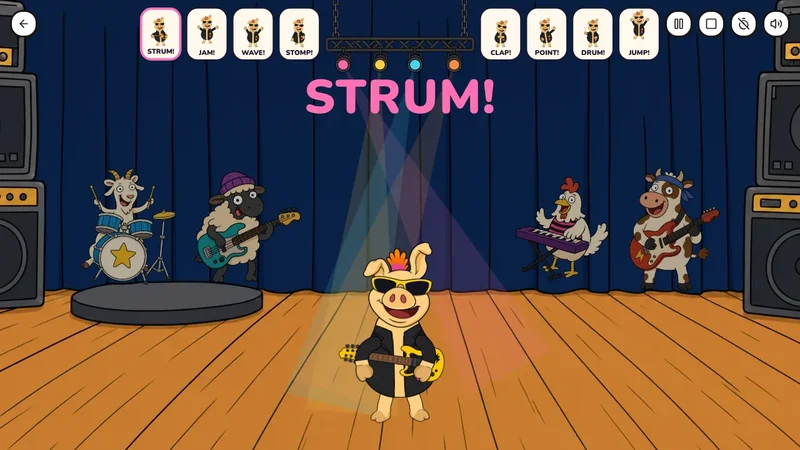
It's a strange feeling to see your classroom puppet on a stage. He'd tell you it was only a matter of time.
Try it in your next class
Find a puppet, give it one weakness and a voice, and let your student help it play. You'll get more reading aloud, more explaining and more laughing than you'd get on your own.
If you want games to play with your puppet, you can try Tembii free with your next lesson.
Happy teaching!
Ready to try it?
Turn your next lesson into an interactive classroom game in under five minutes. No student devices needed.
Sign up freeKeep reading
 guides9 min read
Halloween ESL Games: Spooky Classroom Games for Kids
Three Halloween ESL games that run on your own vocabulary list, one of them free, plus no-tech Halloween activities for ages 4 to 14. Never scary.
 subjects7 min read
Vocabulary Games for A1 Beginners: What Actually Works
Vocabulary games for A1 beginners that respect a tiny word stock: picture-first classics plus digital review games your whole class can play.
 subjects4 min read
How to Run One Game for a Mixed-Level ESL Class
One class, several levels, one game. Practical ways to run ESL review that stretches your strong students without losing your beginners.