
Vocabulary Games for A1 Beginners: What Actually Works
By Tembii Team
What actually makes a vocabulary game work at A1
Most "vocabulary games for beginners" posts give you the same list regardless of level: Bingo, charades, a quiz app, done. That works fine for a B1 class. At A1 it mostly doesn't, because A1 students are working with a genuinely tiny word stock — often fewer than 500 words — and asking them to compete, produce sentences, or read a wall of text turns a vocabulary game into a confidence game they lose.
A1 vocabulary games need different rules than higher-level ones. Here's what actually holds up in a real A1 classroom.
The word stock is small, so the game has to survive repetition. You'll drill the same 10-20 words for a week. A game that gets boring on the third round is a bad fit — you need something with enough structure to replay without students tuning out.
Recognition before production. At A1, a student can often point to the apple long before they can say "I would like an apple, please." A good A1 vocabulary game asks students to recognize, match, or select — not generate. Save open production for A2 and up.
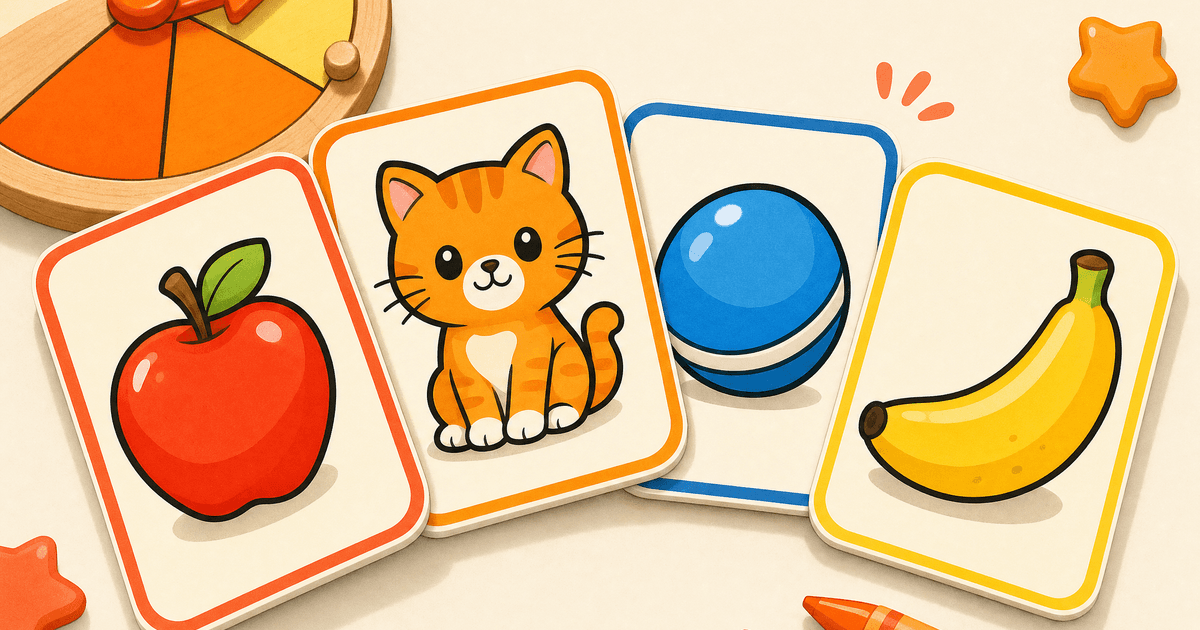
Picture support isn't optional. If a student has to read the word to know what it means, you're testing reading, not vocabulary. Picture vocabulary games — where the image is the prompt or the answer — let a true beginner participate on the same footing as a stronger classmate.
Turns need to be short. A1 attention for any single task is brief, and a long turn for one student is dead air for fifteen others. The best A1 games move in quick bursts: see it, answer it, move on.
The energy has to be whole-class, not one-at-a-time. Elimination and single-player spotlight formats work at higher levels where students can self-correct and recover. At A1, being singled out and getting it wrong in front of the room is exactly the moment a shy beginner shuts down for the rest of the lesson.
Keep those five things in mind and most of the generic listicle advice online either falls away or gets reordered.
Classroom games that already work at A1
You don't need new games to fix A1 vocabulary practice — you need the old ones run correctly. A few classics genuinely earn their place, and it's worth being honest that these are staples, not anyone's invention:
- Picture Bingo. Give each student a grid of images instead of words. You call out the vocabulary; they cover the matching picture. Zero reading required, whole class plays at once, and it survives repetition because the calling order changes every round.
- Total Physical Response (TPR). Call a word, students act it out or touch the matching object/flashcard on their desk. Built for recognition, not production — exactly the A1 sweet spot.
- Flashcard match/Pelmanism. Lay word and picture cards face down, students flip pairs. Slow, quiet, and forgiving — a good warm-up format rather than a whole-class energy game.
- Simon Says with vocabulary. Swap the usual commands for target words ("Simon says touch the banana"). Physical, low-stakes, and it repeats well because the command order is never the same twice.
None of these need technology, and that's the point — they solve the recognition-before-production and picture-support problems on their own. Where they run out of road is variety and pace: you can only run picture Bingo so many times before you want something with more forward motion, teams, and a bit of game energy behind the same vocabulary drill.
Running digital review games at A1 with Tembii
This is where a digital review layer earns its place — not as a replacement for TPR and Bingo, but as what you reach for once the class needs pace, teams, and a change of scenery on the same words.
Tembii takes the lesson material you're already using — a textbook page, a vocabulary list, a photo of the board — and generates a question bank from it. Set the CEFR level to A1 and the question mix leans toward the types that actually work at that level: picture choice, in particular, draws from a curated image bank built for exactly this — showing the image and asking the student to identify the word, or the reverse. That's the digital version of picture Bingo, just with a game wrapped around it.
Because the question bank comes out of seven types (multiple choice, true/false, picture choice, fill in the blank, matching, ordering, and open-ended), you can build an A1 set almost entirely from the recognition-friendly ones — picture choice and matching carry most of the weight — and skip past the types that ask for production. You review the generated questions and approve what you want before anything reaches students, so a question that's too wordy for your beginners is one tap to reject.
From there you pick a game and play it on one screen, students in teams, no devices needed. A short-turn, high-energy game like Wizard's Spell Wheel or Treasure Hunt keeps the whole-class energy that A1 students need — teams answer together, nobody is on the spot alone, and a wrong guess doesn't end anyone's turn. The whole path, from pasting your lesson material to a room playing a game on it, takes under five minutes, which matters when you're trying this between periods rather than planning it the night before.
If you want the mechanics behind why a review game holds a class's attention at all, that's covered separately in how to make vocabulary review fun — worth a read alongside this if A1 isn't your only level in the room.
What to avoid at A1
A few formats that work well for stronger students actively work against A1 beginners, and it's worth naming them so you're not tempted to reach for them out of habit:
- Open-ended production games. Anything that asks a beginner to write or say a full sentence unprompted sets them up to freeze. Save open-ended questions for A2 and above, where students have the base to produce something.
- Text-heavy quizzes. If the question or the answer options are a sentence or more, you've turned a vocabulary check into a reading test. A1 games should be mostly images and single words, not paragraphs.
- Elimination pressure. Games where a wrong answer knocks a student out are fine at B1+, where students can shake off a miss. At A1, getting eliminated in round one — often in front of the class — teaches a beginner that the game isn't for them, not that the word wasn't.
The pattern across all three is the same: A1 vocabulary activities should let a student be wrong quietly and try again, not put a wrong answer on display.
Building CEFR A1 classroom games without starting from scratch
The honest version of this list is short: a handful of no-tech classics that already respect A1's constraints, and a digital layer for when you want pace and teams without giving up recognition-first, picture-supported questions. Vocabulary games for A1 beginners don't need to be simplified versions of a B1 game — they need to be built around what a true beginner can actually do.
Tembii is currently in private beta, built around exactly this kind of level-aware question generation. If you want to try it against your own A1 material, apply for beta access.
Ready to try it?
Turn your next lesson into an interactive classroom game in under five minutes. No student devices needed.
Sign up freeKeep reading
 subjects4 min read
How to Run One Game for a Mixed-Level ESL Class
One class, several levels, one game. Practical ways to run ESL review that stretches your strong students without losing your beginners.
 subjects4 min read
ESL Review Games That Go Beyond Multiple Choice
Tired of review games that are just multiple choice? Here are seven question types that actually build language — and how to play them, not print them.
 guides7 min read
Benefits of Game-Based Learning in the ESL Classroom
Seven evidence-backed reasons game-based learning outperforms traditional methods for ESL students, from higher retention to reduced anxiety.