
Halloween ESL Games: Spooky Classroom Games for Kids
By Tembii Team
Halloween week is the easiest week of the year to get an ESL class excited, and the hardest to keep on task. Costumes, candy talk and a sugar-fuelled mood can swallow a lesson plan whole. Good Halloween ESL games use that energy instead of fighting it.
This guide covers two team games you can run tonight on your own vocabulary list, plus a set of quick no-tech Halloween ESL activities for when the projector is not available. Everything here is written for ages 6 to 14 and kept school-appropriate.
Why Halloween works for vocabulary
Halloween gives you a ready-made bundle of themed lexis: ghost, pumpkin, costume, cobweb, candle, haunted, creaky, spooky. Kids already know the holiday in their first language, so the new English words attach to something they care about. Motivation is high before you say a word.
Here is the part worth remembering, though. You do not need to replace your unit with Halloween words. The best Halloween vocabulary games recycle what your class is already learning, just wrapped in a theme. If this week's unit is food, or family, or past tense verbs, the same word list can be played inside a spooky game. The theme carries the excitement and your list carries the learning.
That is the approach for both games below. You supply the words. The game supplies the atmosphere.
Graveyard Dig: a deduction game for ages 7 to 14
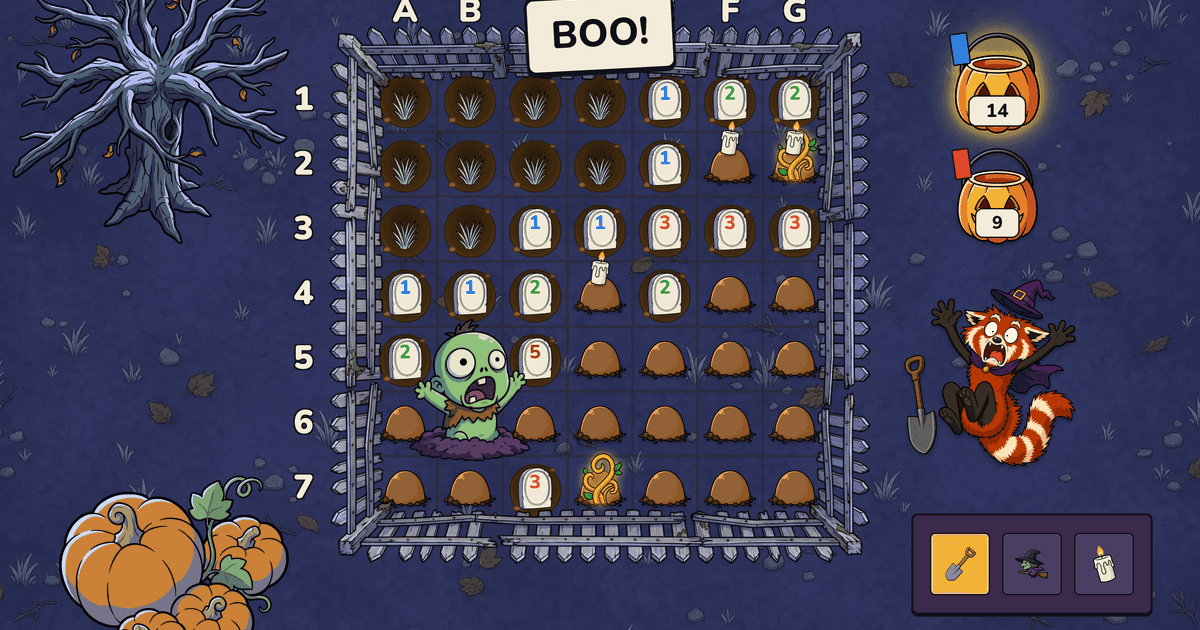
Graveyard Dig is a Halloween version of the classic Minesweeper idea, played by teams on one shared screen. Teams dig a moonlit graveyard plot looking for trick-or-treat candy. Each opened grave shows a number, and that number tells you how many neighbouring graves are hiding a monster: a zombie, a ghost or Frankenstein.
Teams take turns, and the dig has to be earned. A team answers a question from your vocabulary list, and a correct answer earns the dig. Then the real thinking starts. Which grave is safe? Which one is suspicious? Teams mark the graves they distrust with a candle, so the whole class can see the theory being built.
Good digging is rewarded. Candy cascades into the team's pail, and a big enough haul ends in an overflowing jack-o'-lantern jackpot. Bad digging wakes the graveyard. There is also a witch who can be paid to check one grave for you. She is right more often than wrong, which sparks a nice argument about whether she is worth the price.
The useful part for teachers is that it teaches reasoning as well as vocabulary. Students have to talk to their team in English to argue their case: "This one is safe because the number is one." That is real communicative language, and you did not have to script it. It suits older and stronger classes especially well, because the deduction gives them something to chew on beyond the questions.
Haunted Manor Hunt: the cozy option for ages 6 to 14
Haunted Manor Hunt goes in a gentler direction. Each team is a friendly little ghost in a century-old manor at midnight, searching for the keepsakes it lost.
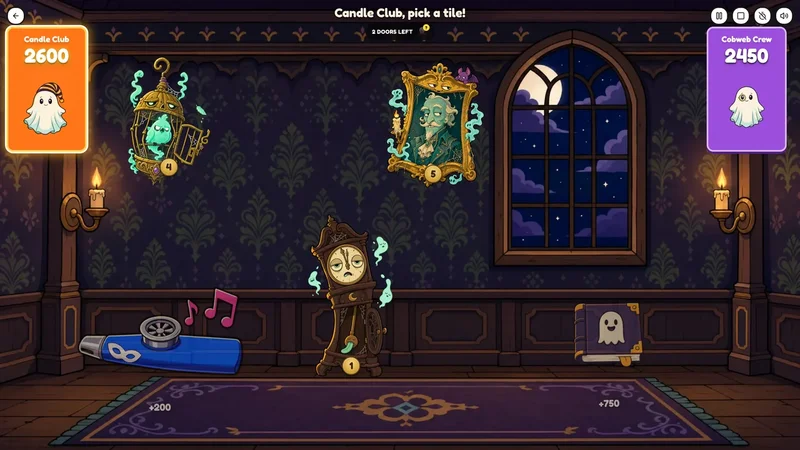
The manor has four rooms, played in order: the Grand Foyer, the Library, the Cellar and the Attic. Each room has five pieces of furniture to open, from a snoring gargoyle statue to a grumbling cuckoo clock. A team answers a question correctly, then picks a piece of furniture to open.
Most pieces hide a keepsake with a name kids remember for days, like the Book of Boo, a Rat King's Crown or a Vampire's Fuzzy Slippers. Some hold a riddle worth points. A few are traps, and now and then a poltergeist swipes a rival team's haul, which produces exactly the right amount of dramatic groaning. Clear all four rooms and the class reaches the dawn finale.
It is cozy-spooky and never scary. If you teach six and seven year olds, or a class with a few nervous students, this is the one to pick. It is also on Tembii's free plan, so you can run it with your class without paying anything. The pick-a-piece-of-furniture mechanic also means every correct answer ends with a small moment of suspense, which keeps quieter teams leaning in.
How to set up Halloween English games from your own word list
You do not need to write questions by hand. The process takes a few minutes, and it is the same for both games. There is a longer walkthrough on the how it works page, but here is the short version:
- Add your material. Paste your vocabulary list or lesson text, photograph a page from your coursebook, or use a PDF.
- Let the questions generate. The AI quiz maker builds multiple choice, true/false, fill-in-the-blank, matching, ordering, open-ended and picture questions from what you gave it.
- Review them. Switch off any question you do not like. You decide what reaches your students.
- Pick a game and play. Run it on one screen or projector while students play in teams.
No student devices and no student accounts are involved. The whole class watches one screen, which is what makes it work in a real classroom with a real budget of tablets (usually zero).
Halloween classroom games with no tech at all
Sometimes the projector is broken or the lesson is a fifteen-minute slot. These Halloween ESL activities need nothing but paper and a bit of noise.
- Pass the pumpkin. Students sit in a circle and pass a pumpkin (or a ball) while music plays. When the music stops, the student holding it must say a vocabulary word and use it in a sentence. Older kids can be asked for a full question using the word.
- Spooky sounds. Play or make sounds, such as creaking doors, howls, wind and footsteps. Students guess and describe: "It sounds like a door. It is creaky." Great for adjectives and it sounds like.
- What's in the cauldron? Hide a few small objects in a bag or box. One student reaches in, feels an object and describes it without naming it. "It is soft. It is round. It is small." The class guesses.
- Monster drawing dictation. Students work in pairs, back to back. One describes a monster ("It has three eyes and two long arms"), and the other draws it. Compare drawings at the end and laugh at the differences.
- Halloween word chain. Start with a word like ghost. The next student must say a word beginning with the last letter, t, and so on around the room. Set a theme to keep it on topic, or leave it open for stronger classes.
- Costume interviews. Students come to class as a character, or pick one from a card. Pairs interview each other: "Who are you? Where do you live? What do you like to eat?"
Each of these works for the same reason the digital games do. They give vocabulary a purpose beyond the worksheet.
Tips for younger or anxious learners
Halloween is not fun for every child. Some students find ghosts and graveyards genuinely upsetting, and a cheerful teacher can miss that.
- Keep it cozy, not frightening. Talk about friendly ghosts, silly monsters and candy. Skip anything gory or intense.
- Let kids opt out. If a student does not want to look at a spooky picture, they can turn away, draw a pumpkin instead or be the team scorekeeper. Say so at the start so nobody has to ask.
- Preview the theme. Tell the class what the game looks like before you start. Knowing that the ghosts in the manor are friendly takes the fear out of it.
- Lead with the gentlest option. For the youngest classes, choose the game that is silly rather than tense, and save the deduction for older groups.
- Name the feelings. Halloween is a good excuse to practise scared, excited, nervous and brave. Asking "How do you feel?" is language practice and a quiet safety check at once.
Halloween ESL games that keep the unit moving
Halloween does not have to be the week where learning stops. With a themed game on top of your normal word list, students stay engaged and your unit still moves forward. The best Halloween ESL games are the ones that feel like a treat but leave a trail of English behind them.
Run the no-tech activities when you need a quick five minutes. Run Graveyard Dig or Haunted Manor Hunt when you want a full lesson built around your own words. Haunted Manor Hunt is free to play; Graveyard Dig is part of Tembii Pro, and the plans are on the pricing page.
Ready to try it with your class? Create your account and build a Halloween game from your own vocabulary list.
Ready to try it?
Turn your next lesson into an interactive classroom game in under five minutes. No student devices needed.
Sign up freeKeep reading
 guides7 min read
Benefits of Game-Based Learning in the ESL Classroom
Seven evidence-backed reasons game-based learning outperforms traditional methods for ESL students, from higher retention to reduced anxiety.
 guides2 min read
How to Make Vocabulary Review Fun
Five practical strategies for turning vocabulary review into an activity students actually enjoy. No more boring flashcard drills.
 subjects7 min read
Vocabulary Games for A1 Beginners: What Actually Works
Vocabulary games for A1 beginners that respect a tiny word stock: picture-first classics plus digital review games your whole class can play.